Africanized honey bees (*Apis mellifera scutellata* hybrids) colonized Maricopa County during the 1990s and present acute safety hazards because they defend territories up to 100 feet from the nest and pursue perceived…
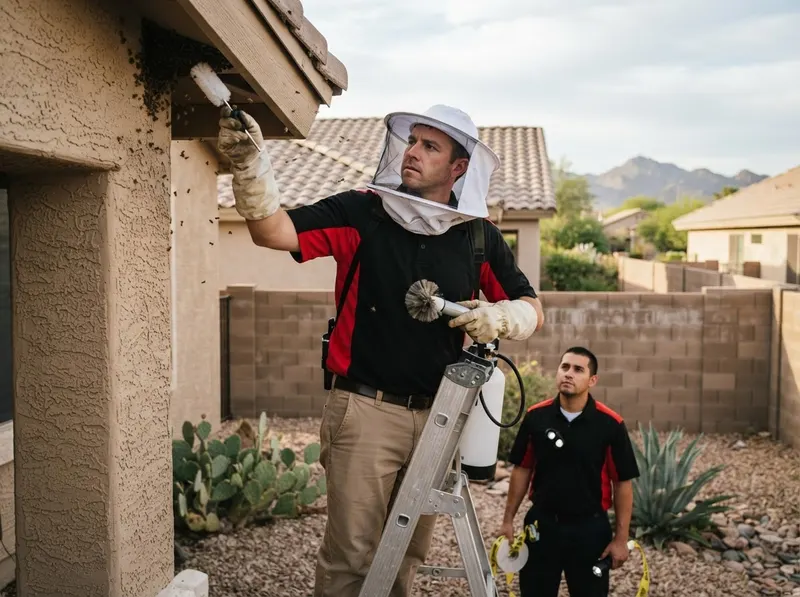
Africanized honey bees (*Apis mellifera scutellata* hybrids) colonized Maricopa County during the 1990s and present acute safety hazards because they defend territories up to 100 feet from the nest and pursue perceived threats for more than a quarter-mile. In communities like DC Ranch, Silverleaf, and Troon North, colonies colonize valve boxes, boulder crevices, parapet roof vents, and chimney caps. A structural eradication differs fundamentally from a simple exterior knockdown. Surface spraying leaves gallons of melting honey and wax inside building cavities, which quickly attracts desert rodents, secondary carpet beetles, and nearby robber colonies. Standard eradication protocol requires complete physical comb deconstruction, cavity sanitization to strip alarm pheromones, and mechanical exclusion sealing using steel mesh rated at 1/8-inch or narrower.
Decision guidance depends strictly on the colony nesting site and flight activity. If a transient swarm forms a temporary cluster on a low palo verde branch in McCormick Ranch or Gainey Ranch, observation over 24 to 48 hours is standard, as migrating swarms frequently depart on their own without structural intrusion. If bees actively enter an irrigation box, eave void, or architectural column in McDowell Mountain Ranch, immediate defensive eradication is required. The trade-off between live bee relocation and eradication involves public safety and genetics: feral colonies established in residential Scottsdale test predominantly Africanized, making live relocation into urban hobby apiaries unviable under regional vector safety standards. Emergency dispatch to properties near the McDowell Sonoran Preserve or Pinnacle Peak Park prioritizes immediate perimeter security to protect residents, children, and domestic pets.
The mechanical eradication process executes in four distinct phases. Step 1: Technicians establish a 100-foot safety perimeter and apply targeted microencapsulated formulations or rapid-knockdown foams directly into the entry aperture. Step 2: Specialized vacuum capture removes defensive worker bees from the immediate perimeter. Step 3: Technicians open the void, cut away the brood comb and honey reserves, and bag all bio-matter for off-site disposal. Step 4: Technicians treat the void with bio-enzymatic odor neutralizers to eliminate masking attractants and seal the exterior opening using elastomeric caulking and copper mesh. Properties in Old Town Scottsdale or South Scottsdale with older utility penetrations require complete envelope audits to prevent re-infestation along shared fascia lines.
Every job gets a firm, written price after a free on-site visit.
Tell us about your africanized honey bee eradication job in Scottsdale and we'll send a clear, written quote, usually the same day.
 Millstone Pest Control