Desert subterranean termites forage beneath concrete slabs and access interior structural framing through slab expansion joints, plumbing penetrations, and post-tension cable points. In Maricopa County, the arid…
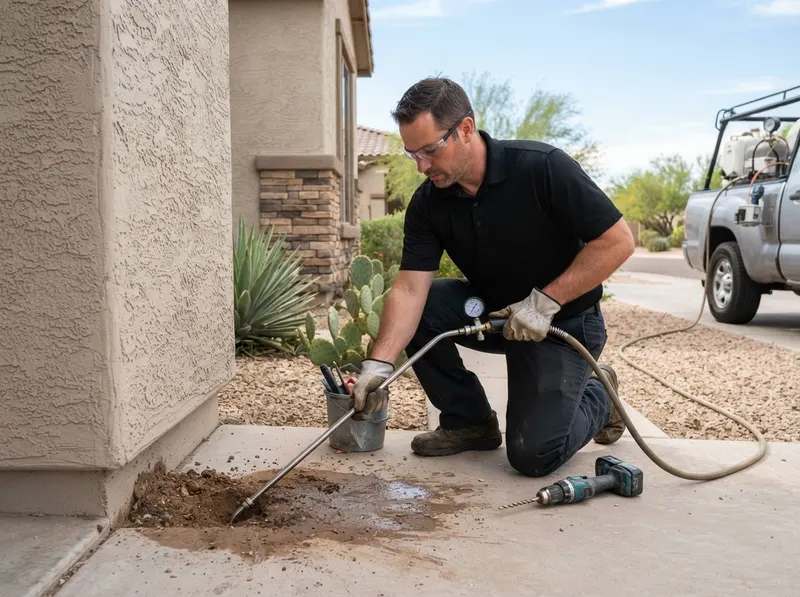
Desert subterranean termites forage beneath concrete slabs and access interior structural framing through slab expansion joints, plumbing penetrations, and post-tension cable points. In Maricopa County, the arid Sonoran climate drives colonies up to 20 feet deep into the soil profile to source moisture. In communities like DC Ranch, Silverleaf, and Troon North, foundation construction frequently incorporates broad post-tensioned slabs surrounded by dense flagstone or decorative concrete hardscaping. Securing these homes requires drilling 0.5-inch holes spaced roughly 12 inches apart through abutting flatwork to inject non-repellent liquid termiticide into the underlying base material, locking the chemical barrier flush against the structural stem wall.
Established properties in Gainey Ranch, McCormick Ranch, and South Scottsdale frequently present expansive landscape irrigation systems, mature trees, and dense shrubbery directly adjacent to stucco perimeters. Standard treatment requires rodding and trenching down 6 inches into the soil immediately adjacent to the stem wall to deposit 4 gallons of termiticide per 10 linear feet. If a property features exterior expansion joints without soil contact, such as tiled patio portals near Old Town Scottsdale or pool decking in McDowell Mountain Ranch, the perimeter barrier must be mechanically threaded through those junctions without compromising water barriers or decorative finishes. For partial or minor localized issues, targeted spot treatments start at the $250 minimum, though continuous whole-home perimeters remain the standard method to prevent colonies from simply shifting along unfortified footings.
Deciding between whole-perimeter liquid treatment and localized structural foam injection depends directly on whether live foraging tubes are restricted to a single plumbing stub or distributed along perimeter footings. Localized foam stabilizes active drywall tube breakouts inside bathroom or laundry walls, but it does not halt subterranean colony movement under the foundation. Complete liquid trenching addresses the underlying colony pathway permanently, carrying the structural trade-off of requiring precise mechanical drilling through adjoining decorative concrete surfaces near entryways and garages. Product selection relies on non-repellent formulations like fipronil that allow worker termites to carry the active ingredient into the subterranean nest, eliminating the reproductive queen through contact transfer within 60 to 90 days.
Every job gets a firm, written price after a free on-site visit.
Tell us about your subterranean termite treatment job in Scottsdale and we'll send a clear, written quote, usually the same day.
 Millstone Pest Control